
|
|
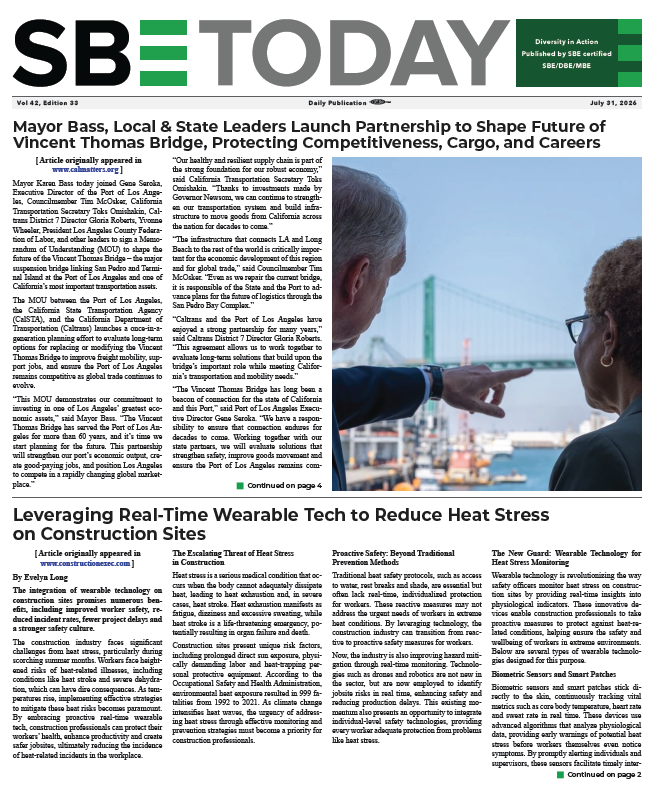
Mayor Bass, Local & State Leaders Launch Partnership to Shape Future of Vincent Thomas Bridge, Protecting Competitiveness, Cargo, and Careers
07/31/2026
[ Article originally appeared in www.calmatters.org ]
Mayor Karen Bass today joined Gene Seroka, Executive Director of the Port of Los Angeles, Councilmember Tim McOsker, California Transportation Secretary Toks Omishakin, Caltrans District 7 Director Gloria Roberts, Yvonne Wheeler, President Los Angeles County Federation of Labor, and other leaders to sign a Memorandum of Understanding (MOU) to shape the future of the Vincent Thomas Bridge – the major suspension bridge linking San Pedro and Terminal Island at the Port of Los Angeles and one of California’s most important transportation assets. The MOU between the Port of Los Angeles, the California State Transportation Agency (CalSTA), and the California Department of Transportation (Caltrans) launches a once-in-a-generation planning effort to evaluate long-term options for replacing or modifying the Vincent Thomas Bridge to improve freight mobility, support jobs, and ensure the Port of Los Angeles remains competitive as global trade continues to evolve. “This MOU demonstrates our commitment to investing in one of Los Angeles’ greatest economic assets,” said Mayor Bass. “The Vincent Thomas Bridge has served the Port of Los Angeles for more than 60 years, and it's time we start planning for the future. This partnership will strengthen our port’s economic output, create good-paying jobs, and position Los Angeles to compete in a rapidly changing global marketplace.” “Our healthy and resilient supply chain is part of the strong foundation for our robust economy,” said California Transportation Secretary Toks Omishakin. “Thanks to investments made by Governor Newsom, we can continue to strengthen our transportation system and build infrastructure to move goods from California across the nation for decades to come.” “The infrastructure that connects LA and Long Beach to the rest of the world is critically important for the economic development of this region and for global trade,” said Councilmember Tim McOsker. “Even as we repair the current bridge, it is responsible of the State and the Port to advance plans for the future of logistics through the San Pedro Bay Complex.” “Caltrans and the Port of Los Angeles have enjoyed a strong partnership for many years,” said Caltrans District 7 Director Gloria Roberts. “This agreement allows us to work together to evaluate long-term solutions that build upon the bridge’s important role while meeting California’s transportation and mobility needs.” “The Vincent Thomas Bridge has long been a beacon of connection for the state of California and this Port,” said Port of Los Angeles Executive Director Gene Seroka. “We have a responsibility to ensure that connection endures for decades to come. Working together with our state partners, we will evaluate solutions that strengthen safety, improve goods movement and ensure the Port of Los Angeles remains competitive. Cargo does not move itself. This Port is home to the greatest workforce in the world who deserve every opportunity to do what they do best on both sides of our iconic bridge. This is about making smart investments today that will support jobs, cleaner operations and a stronger supply chain for future generations.” Completed in 1963, the Vincent Thomas Bridge connects San Pedro and Terminal Island while spanning the Port’s main navigation channel. The international shipping industry continues to deploy larger, more fuel-efficient container ships capable of carrying 22,000 to 24,000 twenty-foot equivalent units (TEUs), which currently cannot pass under the Vincent Thomas Bridge, constraining approximately 40% of the Port’s container terminal capacity north of the bridge. Increasing or eliminating the vertical clearance constraint would allow larger, cleaner, and more efficient vessels to access those terminals, strengthening the Port’s ability to meet future cargo demand. Expanding access for these new, larger vessels, which are capable of running on alternative maritime fuels including e-methanol, would also reduce emissions and advance the Port’s sustainability goals. The Port of Los Angeles is North America’s leading trade gateway and has ranked as the No. 1 container port in the U.S. for 26 consecutive years. In 2025, the Port generated $301 billion in trade and handled 10.2 million container units, sustaining its top rank among U.S. ports. Benefits of Addressing the Bridge Clearance
What the MOU Does
Back To News |
|